


The TEM market is projected to reach $6.84 billion by 2032, driven by 5G adoption and remote work complexities.
- Market leaders offer comprehensive expense optimization through automated invoice processing and contract management
- Key capabilities encompass automated invoice processing, contract management, and real-time cost analytics
- Selection criteria should prioritize scalability, integration capabilities, and proven ROI track records
- Choose providers that demonstrate significant cost reduction potential through billing error detection and usage optimization
Managing telecommunications expenses has become increasingly complex as organizations navigate enterprise voice solutions, 5G networks, and distributed workforces. The telecom expense management companies landscape continues to evolve rapidly, with the TEM market valued at $3.41 billion in 2024 and projected to reach $6.84 billion by 2032, representing a 9.1% compound annual growth rate.
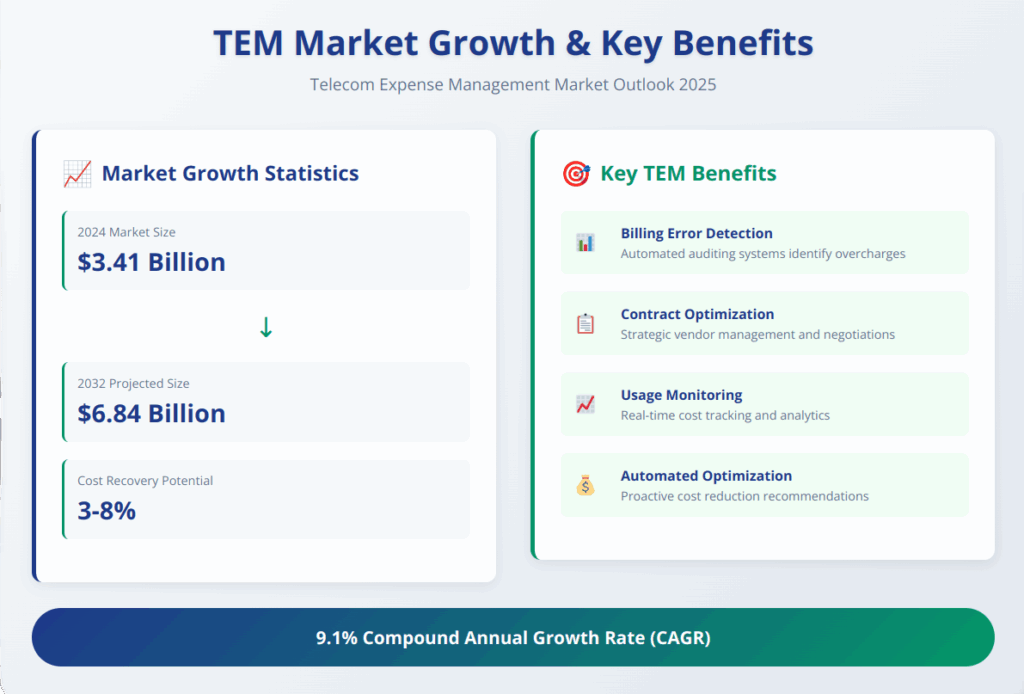
This growth reflects the mounting pressure on IT departments to control spiraling communication costs while maintaining service quality. Many enterprises experience significant telecom overspending due to billing errors, unused services, and inefficient contract management. The right TEM provider can transform this challenge into a competitive advantage through automated cost optimization and strategic vendor management, particularly for organizations managing complex Teams Phone deployments or multi-platform voice solutions.
What Makes Leading Telecom Expense Management Companies Stand Out
The best TEM platforms share several distinguishing characteristics that separate market leaders from basic invoice processing services. Understanding these differentiators helps organizations identify telecom expense management companies capable of delivering meaningful cost reductions and operational improvements.
Comprehensive Invoice Management and Auditing
Top-tier TEM providers offer sophisticated invoice processing capabilities that go beyond simple payment automation. Advanced platforms can detect billing discrepancies, verify contract compliance, and identify unauthorized charges across thousands of services. Industry research indicates that automated auditing systems typically recover 3-8% of total telecom spending through error correction and dispute resolution.
The most effective solutions integrate machine learning algorithms to recognize billing patterns and flag anomalies in real-time. This proactive approach prevents overpayments before they occur, rather than discovering issues months later during manual reviews.
Advanced Analytics and Reporting
Leading providers deliver actionable insights through customizable dashboards and detailed usage analytics. These platforms track spending trends across departments, locations, and service types while providing executive-level summaries for strategic decision-making. Real-time visibility enables finance teams to identify cost optimization opportunities and enforce policy compliance more effectively.

Multi-Carrier Integration and Global Coverage
Enterprise-grade TEM solutions support hundreds of carriers and service providers worldwide. This capability becomes crucial for multinational organizations managing diverse telecom portfolios across different regulatory environments. The ability to consolidate billing from multiple vendors while maintaining detailed cost allocation by business unit significantly simplifies expense management workflows, especially when dealing with complex licensing scenarios across different communication platforms.
Top 10 Telecom Expense Management Companies for 2025
The TEM market includes both dedicated expense management specialists and comprehensive communications providers offering integrated cost optimization. Understanding these distinctions helps organizations choose solutions aligned with their broader technology strategies.
Integrated Communications & Expense Management
Comprehensive providers offering expense optimization as part of broader voice solutions
1. Pure IP (BCM One)
- Key Strengths: Global voice network, platform-agnostic approach, 24/7 follow-the-sun support
- Best For: Enterprises seeking integrated voice communications with built-in expense optimization
- Pure IP delivers comprehensive enterprise voice solutions across Microsoft Teams, Webex, and Zoom with integrated cost management capabilities. Their global infrastructure spans numerous countries with geo-redundant systems, while their platform-agnostic approach enables seamless integration across existing communication environments. With 18+ years of enterprise voice experience and original Microsoft Operator Connect partnership, Pure IP combines advanced voice delivery with proactive expense optimization, eliminating the need for separate TEM vendors. Their managed approach includes contract negotiation, usage monitoring, and cost allocation as integrated components of their voice services.
2. Network Control
- Key Strengths: Contract negotiation, market rate analysis
- Best For: Organizations seeking strategic vendor management
- Network Control offers comprehensive telecommunications lifecycle management with active contract management and market rate benchmarking.
3. Avotus
- Key Strengths: Modular platform design, detailed asset tracking
- Best For: Enterprises requiring customizable solutions
- Avotus provides flexible platform architecture allowing organizations to implement specific capabilities based on immediate needs.
4. Clearview (Valicom)
- Key Strengths: SOC II certification, security features
- Best For: Organizations prioritizing security and compliance
- Clearview combines robust platform capabilities with optional professional services and advanced security features for compliance-focused environments.
Dedicated TEM Providers
Focused solely on telecom expense management and optimization
5. Tangoe
- Key Strengths: AI-powered automation, extensive carrier ecosystem
- Best For: Large enterprises with complex global telecom requirements
- Tangoe’s comprehensive platform integrates expense management, inventory tracking, and lifecycle management with AI-driven cost optimization capabilities.
6. Calero
- Key Strengths: Unified technology expense management, analytics capabilities
- Best For: Organizations seeking combined telecom and cloud cost management
- Calero provides holistic expense management with strong analytics and real-time usage monitoring following its Windstream merger.
7. vCom (vManager)
- Key Strengths: TEM-as-a-Service model, hands-on management
- Best For: Mid-sized companies seeking comprehensive managed services
- vCom combines software capabilities with dedicated account management through its unique TEMaaS approach.
8. Sakon
- Key Strengths: ERP/ITSM integration, global operations support
- Best For: Large enterprises with existing business system integration requirements
- Sakon offers comprehensive visibility with seamless integration capabilities for Enterprise Resource Planning and IT Service Management tools.
9. Brightfin
- Key Strengths: ServiceNow platform integration, automated workflows
- Best For: ServiceNow customers seeking integrated expense management
- Brightfin leverages ServiceNow to deliver streamlined expense management with sophisticated workflow automation.
10. Cass Information Systems
- Key Strengths: Banking integration, multi-currency support
- Best For: Large organizations requiring comprehensive payment and audit services
- Cass provides unique financial services integration with extensive transaction processing capabilities and global coverage.

Essential TEM Selection Framework
Choosing the right telecom expense management companies requires a systematic evaluation approach that balances current needs with future scalability requirements. Organizations should prioritize providers demonstrating proven ROI delivery and operational alignment with existing business processes, particularly those supporting modern cloud communication services.
Technical Integration Capabilities
Modern TEM solutions must integrate seamlessly with existing enterprise systems including ERP platforms, accounting software, and IT service management tools. According to industry analysis, organizations achieving the highest ROI from TEM implementations prioritize providers offering robust API capabilities and pre-built integrations.
Scalability and Geographic Coverage
Enterprise requirements often extend beyond current operational footprints, making scalability and global coverage essential selection criteria. Leading providers support operations across numerous countries with localized compliance and regulatory expertise.
Service Level Agreements and Support Structure
Comprehensive SLA frameworks covering uptime guarantees, response times, and resolution procedures indicate provider commitment to operational excellence. The most successful implementations feature dedicated account management with proactive monitoring and optimization recommendations.
Implementation Best Practices for TEM Success
Successful TEM implementations require careful planning and stakeholder alignment to maximize cost reduction potential and operational efficiency gains.
Comprehensive Baseline Assessment
Before engaging TEM providers, organizations should conduct thorough assessments of current telecom spending, service inventories, and contract portfolios. This baseline enables accurate ROI measurement and helps identify immediate optimization opportunities.
Stakeholder Engagement and Change Management
TEM implementations impact multiple departments including finance, IT, procurement, and end users. Early stakeholder engagement and clear communication about process changes significantly improve adoption rates and long-term success.
Phased Rollout Strategy
Large organizations benefit from phased implementation approaches, starting with high-impact services or geographic regions before expanding to complete portfolios. This strategy allows for process refinement and demonstrates value to skeptical stakeholders.
The Future of Telecom Expense Management
The TEM industry continues evolving rapidly, driven by emerging technologies and changing enterprise communication patterns. Market research indicates that 5G adoption, IoT proliferation, and artificial intelligence integration will reshape expense reduction telecom strategies over the next three years.
AI and Machine Learning Integration
Advanced analytics and predictive modeling capabilities are becoming standard expectations rather than competitive differentiators. Leading telecom expense management companies are investing heavily in AI-driven cost optimization, contract analysis, and usage pattern recognition to deliver proactive recommendations, particularly valuable for organizations managing hybrid communication environments.
Cloud-Native Platform Architecture
The shift toward cloud-native TEM platforms enables greater scalability, faster deployment, and enhanced integration capabilities. Organizations increasingly prefer SaaS solutions offering automatic updates and reduced infrastructure management overhead.
Sustainability and ESG Reporting
Environmental, social, and governance considerations are influencing TEM selection criteria as organizations seek providers supporting sustainability initiatives through optimized resource utilization and comprehensive ESG reporting capabilities.
Frequently Asked Questions
Q: What percentage of telecom costs can TEM solutions typically reduce? A: Leading TEM implementations typically achieve substantial cost reductions through billing error correction, unused service elimination, and contract optimization. Results vary based on current spend management maturity and provider capabilities.
Q: How long does TEM implementation typically take? A: Implementation timelines range from 3-6 months for basic deployments to 12-18 months for complex global rollouts. Phased approaches often deliver initial benefits within 60-90 days while complete functionality develops over time.
Q: Can TEM solutions integrate with existing accounting and ERP systems? A: Yes, enterprise-grade TEM platforms offer extensive integration capabilities through APIs and pre-built connectors for popular business systems including SAP, Oracle, Microsoft Dynamics, and QuickBooks.
Q: What’s the difference between TEM and simple invoice processing? A: TEM encompasses comprehensive telecom lifecycle management including contract negotiation, inventory tracking, usage optimization, and strategic planning, while basic invoice processing focuses solely on payment automation without optimization capabilities.
Q: How do TEM providers ensure data security and compliance? A: Leading providers maintain SOC II certification, implement enterprise-grade encryption, and offer comprehensive audit trails. Many also provide industry-specific compliance support for healthcare, financial services, and government requirements.
Choosing Your TEM Partner for Long-Term Success
The telecom expense management landscape offers numerous capable providers, each bringing unique strengths to different organizational requirements. Success depends on aligning provider capabilities with specific business needs, implementation readiness, and long-term strategic objectives.
Organizations benefit most from telecom expense management companies that combine proven technology platforms with deep industry expertise and commitment to ongoing optimization. The right partnership delivers immediate cost reductions while building foundation for sustainable expense management as communication technologies continue evolving, especially with enterprise communications transformation accelerating across industries.
For enterprises seeking comprehensive voice communications management alongside telecom expense optimization, integrated solutions offer the greatest value proposition. When you’re ready to explore how strategic expense management can transform your telecommunications operations, contact us to discover tailored solutions for your organization’s unique requirements.


